


What Is Net Unrealized Appreciation (NUA)?
NUA refers to the difference between the cost basis (what you or the plan originally paid for the shares) and the current fair market value of employer stock held in a qualified retirement plan.
Under IRS rules, when you take a lump-sum distribution of the entire plan balance, you can:
- Pay ordinary income tax only on the cost basis at distribution.
- Transfer the shares in-kind (without selling) to a taxable brokerage account.
- Defer tax on the appreciation (NUA) until you sell the shares — at favorable long-term capital gains rates (0%, 15%, or 20%) instead of ordinary income rates (up to 37%).
- By making use of the strategy, you could realize tax benefits.
Who Can Benefit from NUA?
- Employees with low cost basis employer stock in 401(k)/Savings Plans (common at companies like ExxonMobil due to long-term holding and stock splits).
- Those separating from service (retirement, age 59½+, or other qualifying events).
- Individuals seeking to diversify concentrated positions while controlling the tax impact.
Not sure if your company stock qualifies?
Our experienced team can help you look at your cost basis and determine if an NUA election makes sense for your retirement timeline.
Request a Complimentary Analysis →How NUA Works – A Real-World Example
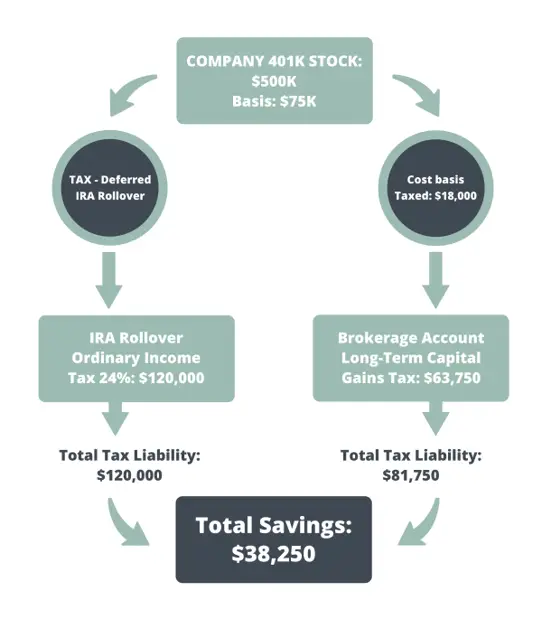
Assume $500,000 current value of company stock with a $75,000 cost basis
- Full IRA Rollover: No tax today. Future distributions taxed at ordinary rates (e.g., 24% bracket = ~$120,000 in taxes over time on this amount).
- NUA Strategy: Pay ordinary income tax on $75,000 basis today (~$18,000 at 24%). Sell later and pay 15% long-term capital gains on the $425,000 appreciation (~$63,750). Total tax: ~$81,750 — a meaningful savings.
Important Requirements & Considerations
- Triggering Event: Must take a full lump-sum distribution of the entire qualified plan balance in one calendar year.
- Lump-Sum Rule: Company stock must move in-kind to a taxable (non-IRA) account — no selling inside the plan.
- In-Kind Transfer: Best for those with substantial unrealized gains and low basis.
- No Partial Rollovers: Early distributions (before 59½) may trigger 10% penalty on the cost basis portion.
- Tax Impact: Once assets are rolled to an IRA, the NUA opportunity is lost forever.
- Holding Period: Coordinate with overall tax planning, RMDs, charitable giving, and estate strategies.
How Annex Wealth Management Helps with NUA + Equity Compensation
We integrate NUA analysis into comprehensive planning for clients with employer stock and equity comp (RSUs, ISOs, NQSOs, PSUs):
Scenario Modeling
Project taxes under NUA vs. rollover strategies using your specific numbers, brackets, and goals.
Timing & Coordination
Align NUA with year-end planning, equity vesting/exercises, charitable gifting of appreciated shares, and retirement transitions.
Risk Management
Post-NUA diversification strategies that reduce concentration risk without unnecessary immediate taxes.
Holistic Team Approach
Work with your CPA and attorney for tax-efficient execution.